Suddenly, everything around you looks like something straight out of a sketchbook. It has a quality akin to that of textured paper and dry, textured paint. You look at your fellow inmates and the wardens, and you see that they, too, appear different. In fact, no one person seems to be rendered in the same medium. You look at your own hands and find that you are almost like a drawing instead of your own full person.
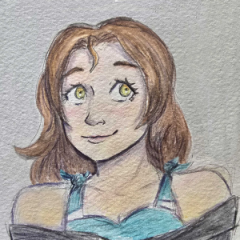
Suzune is depicted with soft, warm watercolor pencils. She is drawn with bright eyes and a warm smile. Something about how she is rendered feels very comforting.
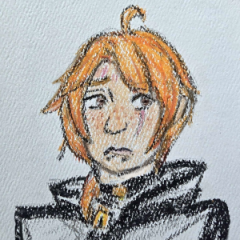
Bow-wow appears in simple crayon. Many words come to mind when you see this kind of drawing: ‘immature, simple, childish’, but none of those feel quite right. Perhaps ‘innocent’ is the word you’re looking for.
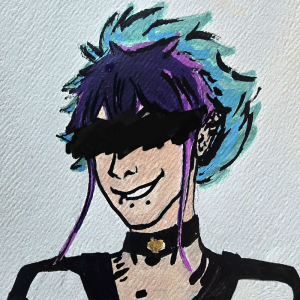
Kaoru is roughly sketched in with scratchy paint pens. Bold colors, stark contrast, and expressive lines highlight much of the impression he has left on Akemi. Or, perhaps, it’s simply that paint pens are easy for vandals to use. His eyes have been roughly scribbled over.
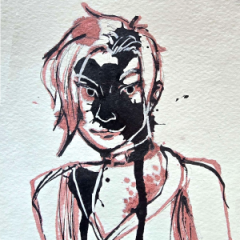
Hikaru contrasts with any of the others to an almost concerning degree. You can scarcely make out his face at first beyond splatters of black and red ink. He is drawn violently, with a malicious smirk showing almost like a photo negative in white ink. The way he is rendered feels…angry.
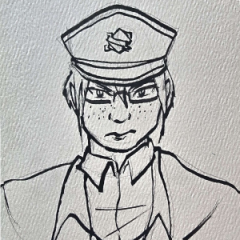
Ei is drawn with what appears to be black ink and a square pen nib. Traditional, rigid, stark, and unforgiving.
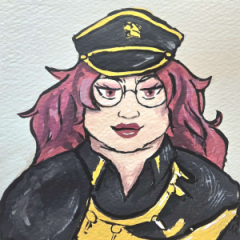
Bea looks to be painted with a matte sort of paint. Tempera, perhaps. Despite the depth of color, something about this art feels immature, flaky, and temporary.
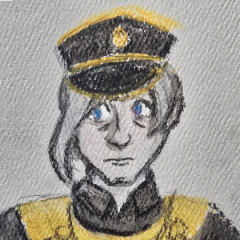
Sie is depicted in loose, half-painted watercolor crayons. Some elements of these crayons have been brushed with water, while others have been left with a rough texture. The colors themselves are soft and weak, with only vague detail to be seen.
Adjusting your eyes to this new and strange sensation, you try instead to focus on your surroundings.
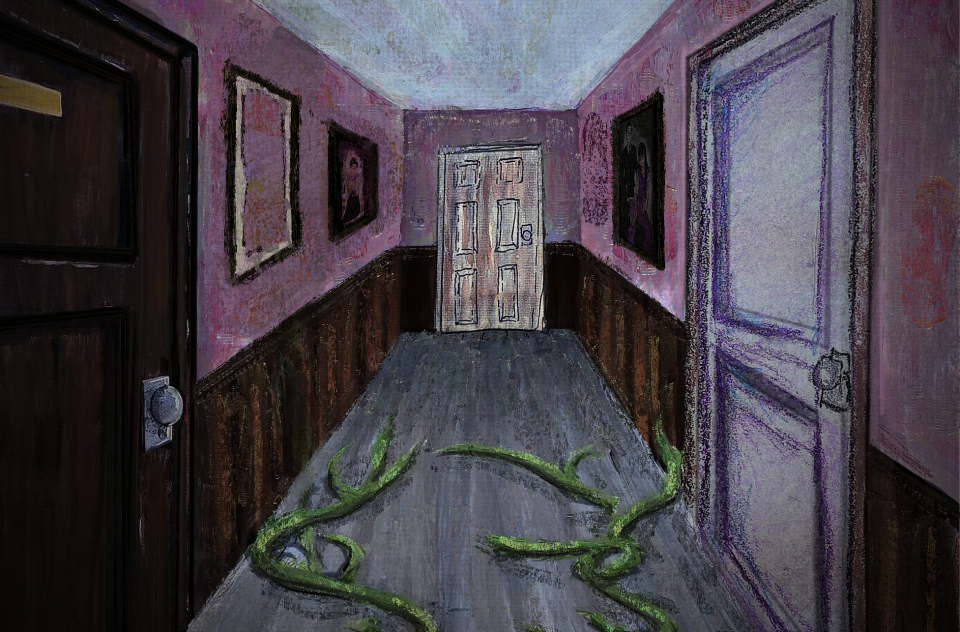
You find yourself in what looks like a hallway within a once-extravagant home. Everything is rendered in thick impasto paint, leaving the finer details in this space far more challenging to parse. The marble floors are cracked, the wallpaper is dull and peeling, the lights are dim. A few dilapidated portraits cling to the walls in varying states of repair. Flower arrangements have been knocked from their podiums and lay, broken and scattered on the floor. There is no clear exit out of this space, as the only potential way out is closed off by a mountain of rubble. To Suzune, who had been in her previous projection, this looks almost like the same environment, only more decayed and fractured than before, with the elegant gallery spaces nowhere to be seen.
Wilted, rotting vines crunch beneath your feet along the entire length of this hallway, marked by chaotic impasto paint. Some wilting vines dangle from holes in the walls and ceilings, but they do not appear to be any kind of threat. They may have dominated this space once upon a time, but now they are long-dead.
Stepping further along this hallway, you see three doors. One door is rendered in detailed acrylic paints, with an official-looking placard set on its surface. One door is of a rich and warm wood rendered in a soft watercolor and ink. The third door is rendered in scribbly crayons with a soft purple color.

